
More Information
Submitted: March 16, 2026 | Approved: March 24, 2026 | Published: March 25, 2026
How to cite this article: Chanda A. Tubular vs. Molded Glass Vial Alkaline Products Delamination Comparative Studies. Arch Biotechnol Biomed. 2026; 10(1): 013-015. Available from:
https://dx.doi.org/10.29328/journal.abb.1001049.
DOI: 10.29328/journal.abb.1001049
Copyright license: © 2026 Chanda A. This is an open access article distributed under the Creative Commons Attribution License, which permits unrestricted use, distribution, and reproduction in any medium, provided the original work is properly cited.
Keywords: Glass delamination; Tubular glass vials; Molded glass vials; Pharmaceutical packaging; Alkaline formulations; Chemical resistance; Surface degradation

Tubular vs. Molded Glass Vial Alkaline Products Delamination Comparative Studies
Anupam Chanda*
B.Sc(Math), Packaging and Polymer Science Technologist(PG), Boston, USA
*Address for Correspondence: Anupam Chanda, B.Sc(Math), Packaging and Polymer Science Technologist(PG), Boston, USA, Email: [email protected]
Tubular and molded glass vials are widely used as primary packaging materials for parenteral products, each offering distinct advantages and limitations in relation to chemical durability and delamination behavior. Tubular vials generally provide superior surface uniformity, dimensional accuracy, and overall chemical resistance, making them suitable for high-value and sensitive formulations. However, the high-temperature forming process can lead to localized compositional variations, increasing the risk of delamination at critical regions such as the base and shoulder.
In contrast, molded vials are produced through a single-step forming process that enables better redistribution of volatile components, resulting in improved structural homogeneity and reduced susceptibility to localized delamination. Despite this advantage, molded glass may exhibit comparatively lower hydrolytic resistance and can be more vulnerable to uniform surface corrosion when exposed to alkaline formulations.
Glass delamination is influenced by multiple factors, including formulation pH, buffer composition, glass chemistry, sterilization processes, and storage conditions. Alkaline products, particularly those containing phosphate or citrate buffers, significantly increase the risk of glass surface degradation. Preventive approaches such as surface treatments, appropriate glass selection, and the use of alternative materials like COC/COP or advanced coatings can mitigate these risks.
Overall, the selection between tubular and molded vials should be guided by product-specific requirements, balancing performance, stability, and cost considerations to ensure optimal container–product compatibility.
Glass vials are widely used as primary packaging materials for parenteral drug products due to their excellent barrier properties, chemical resistance, and compatibility with a broad range of pharmaceutical formulations. Among available types, tubular and molded glass vials represent the two principal manufacturing approaches, each with distinct physicochemical characteristics and performance profiles [1,2]. However, the phenomenon of glass delamination—defined as the formation and detachment of thin glass flakes from the inner surface—has emerged as a critical quality concern impacting product safety, stability, and regulatory compliance [3].
Delamination is a complex, multifactorial process influenced by glass composition, manufacturing conditions, and drug product characteristics such as pH, ionic strength, and storage conditions [4,5]. Tubular vials, formed through high-temperature conversion of glass tubing, often exhibit localized compositional heterogeneity that may predispose them to delamination at stress such as the base and shoulder [6]. Conversely, molded vials, produced via a single-step molding process, demonstrate more uniform distribution of glass constituents but may exhibit lower hydrolytic resistance under certain conditions [7].
The increasing prevalence of biologics, high-pH formulations, and complex drug delivery systems has intensified the need to understand container–closure interactions and mitigate risks associated with glass degradation [8]. Regulatory agencies, including the U.S. Food and Drug Administration (FDA) and European Medicines Agency (EMA), have highlighted the importance of evaluating extractables, leachables, and delamination risks during product development [9].
This study aims to provide a comparative assessment of tubular versus molded glass vials, with particular emphasis on their susceptibility to delamination in alkaline environments. Additionally, it explores current mitigation strategies and emerging material innovations to enhance container performance and ensure product quality.
Cause of delamination
- Formulations with a high pH include phosphate and citrate buffers increase the risk of glass delamination.
- High alkali content in glass could accelerate erosion.
- High temperature during the vial-forming process increase the risk of glass delamination.
- Terminal sterilization (irradiated at 20-40 kGy for 150 min) also is a risk factor for specific products (veterinary parenteral administration), could cause delamination.
- High product-storage temperatures and long exposure times can increase the rate and severity of glass delamination.
Key comparative points
Manufacturing & delamination sites: Tubular vials are formed using intense heat to shape glass tubes, causing evaporation of borates and alkali, resulting in higher risk of delamination at the base/shoulder. Molded vials are formed in a single heat process that allows for better re-incorporation of volatile compounds, reducing surface fragility.
Surface quality: Tubular glass has a smoother, more even, and cleaner surface.
Alkaline product interaction: While historically considered more durable, molded containers can be severely attacked by specific alkaline products (e.g., 15% KCl) compared to tubular, causing higher pH shifts.
Suitability: Tubular vials are better suited for high-value, sensitive, and freeze-dried (lyophilized) products. Molded vials are generally preferred for vaccines and oral liquids.
Dimensional accuracy: Tubular vials offer consistent wall thickness and better dimensional control compared to the more variable, thicker walls of molded vials.
How to prevent delamination
- Treating the surface of the glass vials with materials, such as ammonium sulfate or siliconization can reduce the rate of glass erosion.
- Consider alternative sterilization methods only in rare cases.
- The correct specification for the glass to ensure its suitability for the pH of the product.
- Use COC/COP vial.
- Use of Aluminosilicate glass instead of Borosilicate glass.
Present market demand is syringe barrel and/or plunger coated with silicone. Non-uniform silicone coatings can affect protein stability. The proteins can absorb into the walls of the container. While silicone can reduce absorbtion, excess silicone can form suspended oil-like droplets. Proteins can form around those droplets and change their natural state. New lubricant coatings, such as inert fluoropolymers, are being introduced to replace silicone. As a very inert material, fluoropolymer provides smoothness for the syringe plunger without the irregularities or the issues that have come with silicone. Other new coating materials are being introduced with new types of packaging related to self-injectors, especially injector pens, patches, and transdermal and wearable devices for self-infusion. Extractable and leachable are most important for inhalers and catheters.
Image
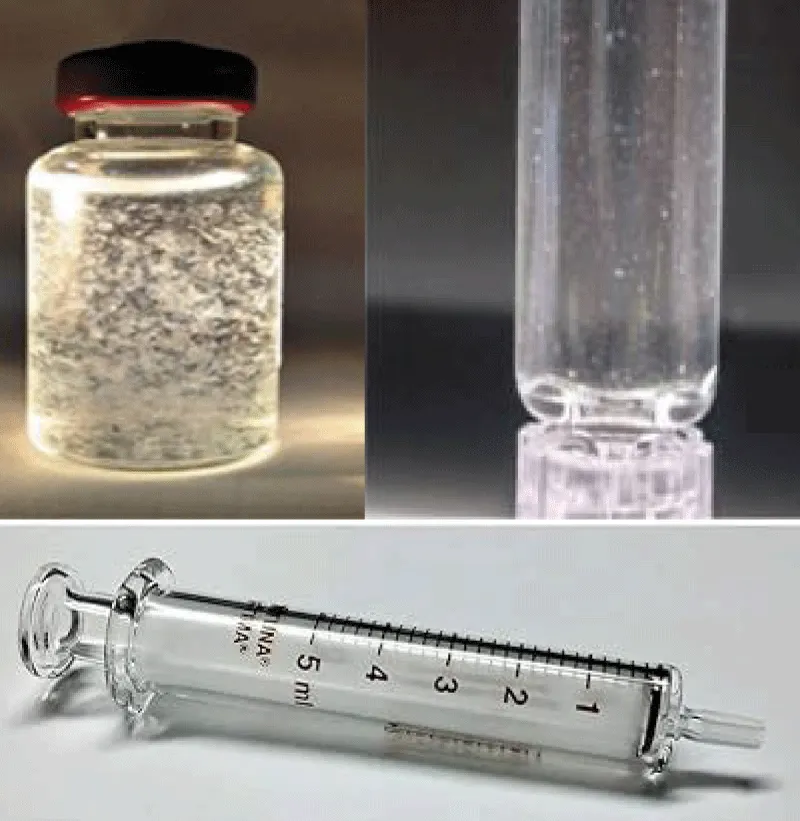
The comparative evaluation of tubular and molded glass vials reveals that their performance is intrinsically linked to both manufacturing processes and end-use conditions. Tubular vials, while offering superior dimensional uniformity and surface smoothness, are more prone to localized delamination due to volatilization of alkali and borate species during high-temperature forming processes [6,10]. These compositional gradients create chemically zones that are particularly susceptible to attack by high-pH formulations.
In contrast, molded vials exhibit a more homogeneous glass network due to controlled cooling and redistribution of volatile components during manufacturing [7]. This structural uniformity reduces the likelihood of localized delamination; however, their comparatively higher alkali content may render them vulnerable to uniform surface corrosion under aggressive conditions, leading to pH shifts and potential product instability [5].
Formulation play a pivotal role in delamination risk. Alkaline buffers, such as phosphate and citrate systems, can accelerate ion exchange processes at the glass–solution interface, resulting in glass degradation and flake formation [4]. Elevated storage temperatures and prolonged exposure further exacerbate this phenomenon by increasing reaction kinetics [11]. Additionally, terminal sterilization processes, particularly gamma irradiation, may induce structural changes in glass surfaces, thereby enhancing susceptibility to delamination [3].
Mitigation strategies focus on both material selection and surface modification. The use of alternative materials such as Cyclic Olefin Copolymer (COC) and Cyclic Olefin Polymer (COP) offers superior resistance to chemical attack and eliminates the risk of glass delamination altogether [12]. Similarly, advanced coatings, including siliconization and fluoropolymer-based lubricants, have demonstrated potential in reducing glass–drug interactions and improving container performance [8]. However, these approaches must be carefully optimized to avoid unintended effects such as protein adsorption or particulate formation.
From an application perspective, tubular vials remain the preferred choice for high-value biologics and lyophilized products due to their precision and cosmetic quality, whereas molded vials are often selected for cost-sensitive, high-volume applications such as vaccines and oral formulations. Ultimately, the choice of container should be guided by a comprehensive risk assessment that integrates formulation characteristics, processing conditions, and long-term stability requirements.
Glass delamination represents a significant challenge in pharmaceutical packaging, particularly for alkaline and sensitive drug formulations. This study highlights that while tubular vials offer superior dimensional control and surface quality, they are more susceptible to localized delamination due to manufacturing-induced compositional heterogeneity. Molded vials, although structurally more uniform, may exhibit broader chemical vulnerability under certain conditions.
Effective mitigation requires a holistic approach encompassing appropriate material selection, optimization of manufacturing processes, and careful evaluation of formulation–container interactions. Emerging alternatives such as polymer-based containers and advanced surface coatings provide promising solutions but must be validated for compatibility and regulatory compliance.
A risk-based selection strategy, supported by thorough analytical characterization and stability studies, is essential to ensure product integrity, patient safety, and regulatory acceptance. Future advancements in material science and coating technologies are expected to further reduce delamination risks and enhance the performance of primary packaging systems.
- Jenke DR. Extractables and leachables considerations for prefilled syringes. PDA J Pharm Sci Technol. 2014;68(5):501–512.
- Iacocca RG, Allgeier M. Corrosive attack of glass vials. Am Pharm Rev. 2007;10(6):82–89.
- FDA. Guidance for Industry: Container Closure Systems for Packaging Human Drugs and Biologics. 2020.
- Iacocca RG, Toltl NP. Glass delamination: a comparison of the inner surface of vials. PDA J Pharm Sci Technol. 2012;66(2):116–129.
- Jenke DR, Castner J. Leachables from glass containers. J Pharm Sci. 2011;100(4):1270–1285.
- Iacocca RG, Bostic J. Delamination of glass: causes and prevention. Pharm Technol. 2013;37(5):40–47.
- Schaut RA, Weeks WJ. Chemical durability of glass containers. J Non Cryst Solids. 2011;357(10):195–201.
- Gupta P. Advances in pharmaceutical packaging materials. Int J Pharm. 2019;567:118–130.
- EMA. Guideline on Plastic Immediate Packaging Materials. 2019.
- Iacocca RG. Surface chemistry of glass vials. J Mater Sci. 2010;45:102–110.
- Ennis RD, Paskiet D. Stability considerations for parenteral packaging. PDA J Pharm Sci Technol. 2013;67(6):548–557.
- Markovic I. Evaluation of polymer containers for biologics. Eur J Pharm Biopharm. 2020;154:123–130.